Twenty Well Stone & Brick Co.

Michael Hardy who's grandfather worked at this brickworks has recently sent me this 1888 newspaper cutting & information relating to the role played by the Twentywell Brick Works in the construction of the Sheffield to Manchester Railway built between 1888 – 1893. Bricks from Twentywell were used in the construction of the Totley (Bradway) Tunnel.

Twentywellsick which is shown marked on the 1900 map below appears to have come from the 12th century name of the area, Quintinewelle - St. Quentin's Well & now it's modern variation Twentywell.

© Crown Copyright. Reproduced with permission of NLS/Ordnance Survey 1900.

Image reproduced with the permission of Coincraft.
From this Twenty Well Stone & Brick Co. Ltd. share certificate dated February 1871 & made out to Tedbar Tinker we know the Company was established at the beginning of 1871. An article found on the web records the Twentywell Stone & Brick Co. is listed in White's 1872 edition. Then the first trade directory that I have is Kelly's 1876 edition & the entry reads The Twenty-Well Stone & Brick Co. Abbeydale Road, Norton, Sheffield. Kelly's 1881 edition now records the address as Bradway, Norton, Sheffield. It is in Kelly's 1891 edition that Tedbar John Tinker is listed as Proprietor of the works & this entry continues until the 1908 edition.
Another newspaper cutting dated March 1898 & info from Michael relating to the sale of the freehold of the Twentywell Brickworks & Quarry and all outbuildings, plant and machinery, the Castle Inn and the adjacent row of dwellings and various properties at Bradway. The Quarry & Brickworks were leased to Tedbar Tinker with the lease shortly to expire.
Lot 1 below refers to the group of buildings which still stand today at the top of Twentywell Lane. The “corner grocer’s shop” now has a different use but is substantially unchanged since 1898. The “6 dwelling houses” listed includes the cottage occupied by the Slater family from the 1880s until after WWII. In 1898 the cottage was rented by my great grandfather William Slater, brick maker and his wife Annie Elizabeth and children and subsequently by his son, my grandfather Joseph Slater and his wife Annie Elizabeth and children including my mother Evelyn Slater born in the cottage in 1927. After Joseph Slater’s death at Twentywell Brick Works in 1928 his widow, my grandmother, continued with the tenancy until she remarried and moved to Sheffield.

Tedbar Tinker may have purchased the quarry & brickworks himself at this date with his lease ready to expiry, but at this moment I do not have this confirmation. He may have carried on leasing the land from the new owners.
The next entry I have for the works is in Kelly's 1928 edition when the listing is Twentywell Brick Co. Twentywell Lane, Dore, Sheffield & this entry continues to the 1935 edition. Tedbar's works closed in 1939 but it was the mid 1950's before the buildings & office were demolished. A housing estate now occupies this site.

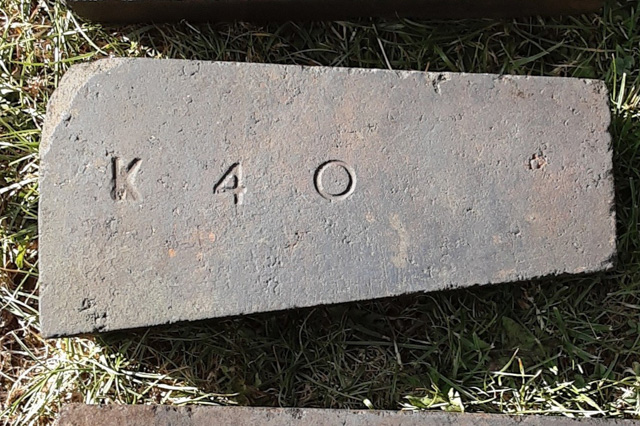
Photo by Frank Lawson.

David tells me this Foden steam wagon was sold to the Twentywell Brick Co. in 1909.
Sorry about the image quality. Joseph Slater died while he was cleaning & oiling the plant before the shift started & the go ahead for the machinery to be started had been given resulting in Joseph falling into the machinery.
.


Malcolm has also sent me this 1930's photo of Joseph's children together with their friends the Wragg family in their garden of the works owned cottage. Note the 20 Well bricks displayed on the wall.
A Twentywell's advert sent by Malcolm, possibly dated late 1870's / 1880's.


Photo by Malcolm Adlington.

Photographed in Brimington, Chesterfield.
Many thanks to Malcolm Adlington for sending me his family history for this post which was researched & collated by his relation Michael Hardy, who is a grandson of Joseph Slater. Also thanks to Michael for the information he has sent me directly.
Klondyke Brick Co.

Photo by Frank Lawson.
The wonderfully named Klondyke Brick Company is listed in White's 1905 edition on Middlewood Road, Wadsley Bridge, Sheffield. Then Kelly's 1908 edition lists the Klondyke Brick Works on Middlewood Road. The name of this brickworks may have come from the nearby Klondyke Villas which were built in 1902. In 1912 the works is recorded as being owned by W.J. Patchett & then by G. Beaumont. By 1919 the works was owned by Daniel Doncaster & I write about him next.

© Crown Copyright. Reproduced with permission of NLS/Ordnance Survey 1900.
1900 O.S. map showing the location of the Klondyke brickworks situated near to Sheffield Wednesday's football ground & just across the road from the Don Brick Works, which I will cover later.

Photo by MF from the Frank Lawson Collection.
With this brick being stamped Klondyke Brick Works it may have been made in 1908 as per trade directory entry for this works.
Daniel Doncaster & Sons

Established in 1778 Daniel Doncaster & Sons were primarily forged steel producers & at the age 21 Daniel Doncaster registered his DD / diamond trade mark, making it one of the oldest in the world. By 1919 the company had branched out into the manufacture of bricks & had taken over the works previously run by the Klondyke Brick Co. Kelly's 1923 edition records Daniel Doncaster & Sons at the Klondyke Brickworks, Middlewood Road, Hillsborough, Sheffield. This entry is then repeated in Kelly's 1925 & 1935 editions. The company closed it's brickworks in 1936 & the site now has houses built on it. The location of Daniel Doncaster's brickworks can be seen on the 1900 OS map in the previous entry for the Klondyke Brick Co. I photographed the DD brick (below) at Wortley Top Forge Museum, so it may be a rarity with it not having the diamond symbol stamped into it.

Don Brick Co.

Photo by Frank Lawson.
The Don Brick Co. is listed in White's 1901 edition at Leppings Bridge, Sheffield.

© Crown Copyright. Reproduced with permission of NLS/Ordnance Survey 1900.
1900 map showing the location of the Don Brick Works on Leppings Lane which was situated across the road from Sheffield Wednesday's football ground.

Ripley, Hillsborough

Henry Ripley is listed as running his Walkley Lane Brickworks in Hillsborough in directories dating from 1900 to 1904. I have coloured this works green on the 1903 OS map below.

It appears Ripley also made the Hillsborough brick below & owned another brickworks at Loxley with Malc Gibbons finding his Hillsborough & Loxley brick.


Nunnery Colliery was sunk in the early 1860’s close to the city centre of Sheffield & a brickworks was established in the early 1900’s, producing half a million bricks per month. The colliery & brickworks were Nationalised in 1947 with the pit closing in 1953 & I also expect the brickworks closed at the same time. Today Parkway Avenue runs through the middle of this site with industrial units built on both sides.

The course of one of the railway lines which runs to the north of the colliery is now the tram route into the city centre & the Sheffield Parkway road now enters the city to the south of the colliery through the word Lane in Nunnery Lane.


I first start with events that took place in 1864 when the Great Sheffield Flood took place. An account of which can be read at this link & from where I have gathered the following information.
https://www2.shu.ac.uk/sfca/postscript.cfm
On the 11th & 12th of March 1864 the newly built Dale Dyke reservoir burst it's banks & flooded the Loxley valley resulting in loss of life, damage to houses & industrial properties. One of the claims for compensation was by Thomas Marshall & William Crapper who owned the Storrs Bridge brickworks in Loxley & were described as clay & brick dealers. Marshall & Crapper put in a claim for compensation which totalled to £1,600 pounds for the loss of their buildings, brick production & equipment etc.


Photo by Malc Gibbons reproduced courtesy of the "Old Bricks" website.
Nunnery Colliery Co.


© Crown Copyright. Reproduced with permission of NLS/Ordnance Survey 1900.
The course of one of the railway lines which runs to the north of the colliery is now the tram route into the city centre & the Sheffield Parkway road now enters the city to the south of the colliery through the word Lane in Nunnery Lane.

Photo by Frank Lawson.

Produced at the colliery after 1947 with it being marked NCB - National Coal Board.
John Gregory & Sons

Trade directories have revealed that John Gregory & Sons over the years have owned five brickworks in Sheffield. So I start with White's 1879 edition & it lists John Gregory & Sons at 292, London Road (offices); works, Wolseley Road & Hurfield Hill, Gleadless, Sheffield & these two works are shown on the two maps below.

© Crown Copyright. Reproduced with permission of NLS/Ordnance Survey 1892.
This 1892 OS map shows the Wolseley Road works in Lowfield & the 1897 OS map below shows the Hurl Field Hill works, but it is marked as disused by this date.

© Crown Copyright. Reproduced with permission of NLS/Ordnance Survey 1897.
Kelly's 1881 edition just lists the company at it's office address of 292, London Road & works, Hurlfield, Gleadless. I then found many Notices in the London Gazette recording that the company of John Gregory & Sons had gone into Liquidation. The first dated 11th of November 1881 records that John Gregory the elder of Wostenholm Road, Sheffield, William Gregory of Hurlfield & John Gregory the younger of Highfield Place, Sheffield were all co-partners in this company, so I am taking it that William & John junior were the sons. The rest of these Notices record the various amounts of Dividend that John Gregory, the elder was to pay & the one dated 10th of June 1884 is the last one found. I am assuming it took just over two years to finally close this business. However, Kelly's 1893 edition records this entry in the brick makers section - John Gregory & Sons, 89, Wolseley Road, Sheffield, possibly home or an office address. So it appears at this date the company of John Gregory & Sons were still active & may have still been operating the Wolseley Road brickworks.

We then find in White's 1901 edition the entry for John Gregory & Son Limited, so I am assuming John Gregory the elder had sorted out his debts & this time formed a limited company in the same name. So White's 1901 edition lists Gregory's had three new works & the entry is as follows;- John Gregory & Sons Ltd., registered office, 623, Abbeydale Road & Sheaf brickworks; & Marriott Wood brickworks, Millhouses; & Ecclesall Road brickworks, Sheffield. Maps showing these three works are placed in the same order.
Sheaf Brickworks, Abbeydale Road (red).

© Crown Copyright. Reproduced with permission of NLS/Ordnance Survey 1903.
Marriott Wood Brickworks, Archer Road (red), Millhouses.

© Crown Copyright. Reproduced with permission of NLS/Ordnance Survey 1903.
Ecclesall Road Brickworks.

© Crown Copyright. Reproduced with permission of NLS/Ordnance Survey 1920.
A photo of the Ecclesall Road works can be seen at this link.
If you click on the zoom image tab, it opens a new page with a closer view of the brickworks.
Gregory's three brickworks continue to be listed in several directories up to White's 1911 edition. We then find in White's 1919 edition & from now on, only the Ecclesall Road works is listed, so the other two works must have closed by 1919. A Sheffield Telegraph article records that William Gregory at the age of 51, died on the 18th of October 1924 at The Gables, Hathersage & it states that he played an active roll in the running of the extensive business of John Gregory & Sons. The last trade directory that I have recording the Ecclesall Road works is Kellys 1935 edition. The exact date when this last of Gregory's brickworks closed is unknown, however I have found in a 1942 Ministry of War document regarding the status of brickworks during the war, if they are open or not, that the entry for John Gregory & Sons has been crossed out, so I am assuming the brickworks had closed by 1942.
Webster & Co.

Photo taken at Barlborough Heritage Centre.
As just wrote in the last entry the Marriott Wood Brickworks had been run to at least 1911 or even up to WW1 by John Gregory & Sons, but we find in Kelly's 1923 to 1935 editions the entry is Webster & Co, (Sheffield) Limited, manufacturers of silica bricks, fire bricks, magnesite, bricks, gangster, compo & building bricks at the Marriott Wood Works, Archer Road, Sheffield & trading as "Webco, Sheffield." A Ministry of War document dated 1942 records this works as being closed, but under the care of the Ministry. I have found during the war that many brickworks were used to store armaments. It is unknown for certain if this was the case for this brickworks, but I expect Sheffield played it's part in producing ammunition with it being a steel town & then storing them until they were needed. Whether this brickworks reopened after the war is unknown.

© Crown Copyright. Reproduced with permission of NLS/Ordnance Survey 1920.
1920 map showing the location of Webster's brickworks on Archer Road which I have coloured yellow. Please note that some of the buildings on this map are different to the ones shown on the 1900 map in the Gregory entry, the clay pit had certainly expanded in size by this 1920 map.
A 1935 photo of this brickworks on Picture Sheffield can be seen at this link.
If you click on the zoom image tab, it opens a new page with a closer view of the brickworks.

Photo by Simon Patterson.

Thomas Marshall & William Crapper
Thomas Marshall - Carblox

© Crown Copyright. Reproduced with permission of NLS/Ordnance Survey 1903.
https://www2.shu.ac.uk/sfca/postscript.cfm
On the 11th & 12th of March 1864 the newly built Dale Dyke reservoir burst it's banks & flooded the Loxley valley resulting in loss of life, damage to houses & industrial properties. One of the claims for compensation was by Thomas Marshall & William Crapper who owned the Storrs Bridge brickworks in Loxley & were described as clay & brick dealers. Marshall & Crapper put in a claim for compensation which totalled to £1,600 pounds for the loss of their buildings, brick production & equipment etc.
A full list can be read at this link. https://www2.shu.ac.uk/sfca/claimDetails.cfm?claim=5-4802
In the 1861 census William Crapper is listed as a Farmer & living at Storrs Grange. The listing records William was employing 2 men at his farm & 2 men at his clay mine with all four men living at Storrs Grange. The 1851 census only records William Crapper as a farmer, so from this census we know William Crapper had gone into partnership with Thomas Marshall by 1861. Thomas Marshall is listed as a Farmer & Brick Manufacturer in the 1871 census. Marshall & Crapper are listed in White's 1879 edition as brickmakers in Loxley, Sheffield, however I found William Crapper & Thomas Marshall had dissolved their partnership in November 1878 with Thomas Marshall staying on at this works. This November 1878 advert also record Thomas Marshall was selling off various types of fire bricks made by Crapper & Marshall.


 Photos by Jim Stevens.


With Frank Lawson photographing this H. & W. C. in a Sheffield only brick collection I am taking it that the letters stand for Henry & William Crapper. An April 1892 newspaper job advert by Henry Crapper records he was requiring an experienced Brick Burner accustomed to operating a Hoffmann Kiln. Henry Crapper is listed in Kelly's 1893 edition at Wisewood, Sheffield & the location of the Wisewood Brick Works can be seen on the surveyed 1901/03 map below coloured yellow. This works is also named as such on the 1890 map.


Charles Keyworth is recorded as the proprietor of the New Patent Plastic Brick Company on Halifax Road, Wadsley Bridge, Sheffield from 1898 to 1913. Mrs Elizabeth Brindley is then recorded as proprietress at the works in 1916. A gentleman on the Sheffield Forum website has put forward the theory that Mrs. Elizabeth Brindley could have been Charles' married daughter & had taken over the works after his death. The Wadsley Bridge works on Halifax Road is then recorded as being operated by the Sheffield Brick Co. in Kelly's 1919 edition & this works is still shown as being in operation on a map dated 1948.


This Wadsley Bridge Brick Co. brick could have been made by Charles before he renamed his company to the New Patent Plastic Brick Co. From the few trade directories that I do have dated 1901 to 1908, the works is listed as the N.P.P. Brick Co., so I am working on the theory that the company could have existed just as the Wadsley Bridge Brick Co. before 1901. Only by finding earlier trade directories will resolve this matter.
In the 1861 census William Crapper is listed as a Farmer & living at Storrs Grange. The listing records William was employing 2 men at his farm & 2 men at his clay mine with all four men living at Storrs Grange. The 1851 census only records William Crapper as a farmer, so from this census we know William Crapper had gone into partnership with Thomas Marshall by 1861. Thomas Marshall is listed as a Farmer & Brick Manufacturer in the 1871 census. Marshall & Crapper are listed in White's 1879 edition as brickmakers in Loxley, Sheffield, however I found William Crapper & Thomas Marshall had dissolved their partnership in November 1878 with Thomas Marshall staying on at this works. This November 1878 advert also record Thomas Marshall was selling off various types of fire bricks made by Crapper & Marshall.
Thomas Marshall died on the 7th of March 1881 & from my findings it appears he only had one son, Arthur born 1870 & he was only 11 when his father died. With finding Arthur in the 1891 census now aged 21 as a Fire Brick Manufacturer I can only assume someone else was running the Storrs Bridge Works between 1881 & 1891 on behalf of the Marshall family. I have found Thomas Wragg the Younger, a fire brick maker himself was one of the Executors of Thomas Marshall's Will, so he may have been running the works until Albert took over.
Thomas Marshall & Co. are next listed in Whites 1901 edition at Storrs Bridge, Loxley with Marshall concentrating on producing refractory bricks, an example of which is shown next & is stamped Thomas Marshall Fire Brick Co. I have also acquiring a red brick version of this stamp mark, so some house bricks were produced by Marshall. Arthur Marshall is recorded in the 1901 census as a Brick Manufacturer. Two of Arthur's sons were to join him at the works, Thomas b.1896 at the time of his marriage in 1919 is recorded as a Manager in a Fire Brick works, then Arthur junior b.1903 is recorded as a office clerk at his father works in the 1921 census. Third son William b.1900 sadly died in the First World War.
In December 1936 Thomas Marshall & Co. Ltd advertised they were manufacturers of all types of ladle & casting pit refractories, fire bricks, insulating products & domestic fire-backs & cheeks etc. I next found the company is listed as exhibiting it's products at the 1937 British Industries Fair in Birmingham. The 1939 census records both Thomas & Arthur junior as Directors & Managers of a Fire Brick Works. Arthur Marshall senior died in February 1943.


In 1950 Thomas Marshall Co. Ltd. & Morgan Crucibles went into partnership creating a subsidiary company called Carblox Ltd., manufacturing carbon refractory bricks at the Storrs Bridge Works & four examples are shown below. However in October 1958 Morgan Crucibles disposed of it's financial interests in Carblox to Thomas Marshall & Co. giving them full control of Carblox in this friendly de-merger.


In June 1959 a new company called Thomas Marshall & Co. ( Loxley) Limited was registered to run Carblox & three other brick works within the Marshall Group. The Directors are listed as Thomas Marshall, Chairman & joint Managing Director; Arthur Marshall, joint MD; William Thomas Hall, Thomas Anthony Marshall, Works Manager, Charles William Marsden & Kenneth Cowling.
When Thomas Marshall (b.1896) died in January 1965 probate was given to Arthur Marshall (b.1903) & William Thomas Hall, both listed as Directors. Thomas Anthony Marshall b.1932 was the son of Arthur Marshall b.1903. So in all there were four generations of Marshalls at this Storrs Bridge Fire Brick Works.
The last newspaper job adverts found to Carblox requiring operatives to manufacture their carbon refactories is in October 1973. I then found the Storrs Bridge Works was taken over by Hepworth Refractories in 1987, whether they continued to manufacture these carbon bricks afterwards is unknown.
William & Henry Crapper
Crappers Brick Co.
After Thomas Marshall & William Crapper had gone their separate ways in 1878, I then found by the mid 1880's William Crapper & Henry Crapper were operating the Wisewood Brickworks which was further down the Loxley Valley producing red house bricks. A September 1880 newspaper job advert reveals Henry Crapper was operating a Coal & Gangster Works at Wisewood & was requiring a Strong Youth as a Trammer. Then at the time of Henry's 2nd marriage in March 1884 he is listed as a Coal Merchant in Loxley. So it appears that brick making was established at this coal & gangster works when William joined Henry in the mid 1880's. William Crapper died on the 8th of October 1887 aged 74. After spending several hours searching Ancestry & Family Search website I have established William & Henry were uncle & nephew. Henry's father was Jonathan Crapper, a farmer & shoe maker 1803-1887, who was brother to William Crapper 1812-1887. Jonathan & William's father was Joseph Crapper 1773-1852 who in the 1851 census is listed as a retired miner aged 78 & living with William in Storrs, Bradfield.

Photo by Frank Lawson.
With Frank Lawson photographing this H. & W. C. in a Sheffield only brick collection I am taking it that the letters stand for Henry & William Crapper. An April 1892 newspaper job advert by Henry Crapper records he was requiring an experienced Brick Burner accustomed to operating a Hoffmann Kiln. Henry Crapper is listed in Kelly's 1893 edition at Wisewood, Sheffield & the location of the Wisewood Brick Works can be seen on the surveyed 1901/03 map below coloured yellow. This works is also named as such on the 1890 map.

© Crown Copyright. Reproduced with permission of NLS/Ordnance Survey surveyed 1901/03 published 1906.


Photo by Frank Lawson.
With these three bricks being stamped Exors, I found Henry had passed away on the 13th of June 1893 aged 49 & his works was being run by the Executors of his Will, William Frankish & Marshall Nuttall. White's 1897 edition reads Henry Crapper (Exors of), Wisewood, Loxley.
A June 1899 newspaper article advertises the Wisewood Brickworks at Stud Fields was being put up for sale as a going concern & I next found the new owners of this works to be Crappers Brick Co. Limited which had been registered in August 1899 with a capital of £5,250 in £10 shares. The local business men behind this company were John & William Hayhurst, Frank Eyre, Henry Ripley & Robert Craig. The entry in White's 1901 edition is the first listing for Crappers Brick Co. Limited, with Robert Craig as Secretary; office address, 22, York Street, Sheffield; Works, Loxley.

White's 1905 edition lists the Crappers Brick Co. & Robert Craig, but this time just with the office address. This company does not appear in White's 1908 edition, so I am assuming the works had closed by then. I next found the 1920 map shows the Boundary Rolling Mill (steel) had been built on this former brickworks site.
The Wisewood Brick Co. / Brick & Tile Co.

Photo taken at the Barlborough Heritage Centre.
The Wisewood Brick Co. was registered on the 28th of August 1899 with a capital of £3,000 in £10 shares as brick, tile, pipe & terra cotta manufacturers, dealers in gannister, coal, sand, stone, lime & timber etc. The first directors of this newly formed company were Frederick Crawshaw, Authur Bescoby, Frederick Laycock & William Frankish who became Managing Director. Now William Frankish had administered Henry Crapper's company after his death up to when the Crappers Brick Co. took over the Wisewood / Studfield Works in June 1899. Therefore I have come to the conclusion William Frankish with having had a taste of running a brick works had decided to set up a new works just a little further down the Loxley Road to compete with the Crappers Brick Co. By calling his company the Wisewood Brick Co. I bet it caused some confusion for a while with Crappers operating the Wisewood Brickworks.
The Wisewood Brick Co. is first listed in White's 1901 edition with William Frankish as Managing Director & I have coloured this new works purple on the 1920 OS map below. I also note by the 1920 map the works now had a Hoffman Kiln replacing the Staffordshire or Newcastle kiln shown on the 1901 map.

© Crown Copyright. Reproduced with permission of NLS/Ordnance Survey 1920.
The Wisewood Brick Co. is next recorded in the London Gazette as being voluntarily wound up at an extraordinary General Meeting of the Company on the 16th February 1904. This Freehold works was put up for sale at an auction on the 6th March 1904.
White's 1905 edition reveals the new owners of this works were the Wisewood Brick & Tile Co. Ltd, Wisewood, Sheffield, but I've not been able to find who was behind this new company. White's 1908 now records the Wisewood Brick & Tile Co. with the address of Loxley Road, Malin Bridge, Sheffield.

Photo by Frank Lawson.
This frog design was used by many local brick companies & we can date it's introduction to around 1910. The Wisewood Brick & Tile Co. does not appear in White's 1919 edition, however I found the Loxley Road, Malin Bridge Works is listed as being owned by the Sheffield Brick Co., so it appears the Sheffield Brick Co. had taken over this works by 1919. In August 1919 the Sheffield Brick Co. were advertising for a Brick Burner at their Loxley Road Works. With this Loxley Road Works not being listed along with Sheffield Brick Co's other works in White's 1923 edition, I am assuming it had closed by 1923.

Photo by Simon Patterson.
It is unknown who made this Loxley brick, but it will have certainly been made at one of works in the Loxley - Wisewood area.
C. Keyworth.

Photo taken at the Barlborough Heritage Centre.
Charles Keyworth is recorded as the proprietor of the New Patent Plastic Brick Company on Halifax Road, Wadsley Bridge, Sheffield from 1898 to 1913. Mrs Elizabeth Brindley is then recorded as proprietress at the works in 1916. A gentleman on the Sheffield Forum website has put forward the theory that Mrs. Elizabeth Brindley could have been Charles' married daughter & had taken over the works after his death. The Wadsley Bridge works on Halifax Road is then recorded as being operated by the Sheffield Brick Co. in Kelly's 1919 edition & this works is still shown as being in operation on a map dated 1948.

© Crown Copyright. Reproduced with permission of NLS/Ordnance Survey revised 1901.


Photo by MF courtesy of the Frank Lawson Collection.

Photo by Frank Lawson.
The New Patent Plastic Brick Co. example above was more than likely made during Charles tenure of the works. The 'New Patent Plastic' part of the company's name suggests that the works was now using a Hoffmann type kiln to produce their bricks. Many brick companies which includes Nottingham, Sheffield, Leeds & Leicester to name a few added Patent to their company name after they had built these patented Hoffman kilns which vastly increased their brick production output.

Photo by Frank Lawson.
Frank has found two examples of these key bricks in Sheffield, so he has suggested that Charles Keyworth may have made these bricks with the key mark being his trade mark.

Photo by Frank Lawson.
This Wadsley Bridge Brick Co. brick could have been made by Charles before he renamed his company to the New Patent Plastic Brick Co. From the few trade directories that I do have dated 1901 to 1908, the works is listed as the N.P.P. Brick Co., so I am working on the theory that the company could have existed just as the Wadsley Bridge Brick Co. before 1901. Only by finding earlier trade directories will resolve this matter.
I wish to thank the following in helping me bring the history of these Sheffield brickmakers to the web :-
Malcolm Adlington & Michael Hardy - 20 Well family info & photos
Frank Lawson - photos & info
Simon Patterson - photos
Barlborough Heritage Centre - photos
The contributors of the Sheffield History website


