Tuesday, 5 November 2019

Burton-on-Trent Brickworks

From old maps I have established brickmaking took place in three areas of Burton on Trent & these were in Stapenhill, Winshill & Shobnall Road. There was also a works in nearby Anslow which I have included in this post. 

I write about each of these three areas in turn & in most cases I have been unable to establish which brickmaker owned which brickyard due to the fact that trade directories do not give a brick yard/works address for these brickmakers, so I can only show their bricks together with the trade directory entries found. Then in each of the three areas, I list the other brickmakers found in trade directories to which stamped bricks have yet to be found.   


Stapenhill

The first three OS maps shown below dated 1882, shows there were four brick yards on Rosliston Road (dark green) Stapenhill. The red yard is shown on the top two maps with it being situated on the edge of both these maps, then the green yard is shown on both maps two & three. There were three yards situated on or near Stanton Road (orange). Only the two brickworks on Stanton Road are still shown on the 1900 OS map with the rest having closed by 1900. 

© Crown Copyright. Reproduced with permission of NLS/Ordnance Survey 1882.

© Crown Copyright. Reproduced with permission of NLS/Ordnance Survey 1882.

© Crown Copyright. Reproduced with permission of NLS/Ordnance Survey 1900.


Photos by Nigel Furniss.

I start with John Rowland who is listed in Wright's 1874 & Kelly's 1876 editions at Stapenhill. Which of the seven Stapenhill yards he owned is unknown. My Dad would have liked to have seen this brick because his first name was Rowland with a w. Alas this brick turned up 30 years to late for him to have seen it. If it had turn up all those years ago I am sure he would have put it on his mantlepiece !


Photos by Frank Lawson.


Photos by Vicki Eaglefield.

With a photo of a R. Scattergood, Cannock blue coping brick turning up, this brick has lead me to delve deeper into the Scattergood Family & this blue brick was made by Robert junior, but I first start with his father, Robert senior, Robert junior & three other brothers making red bricks in Stapenhill, Burton.

Robert Scattergood snr was born in 1803 & the 1851 census records him aged 48, a brickmaker & married to Mary together with their 6 sons & 1 daughter in Burton. In the 1851 census second son James aged 19 b.1832 is listed as a brickmaker & fourth son Edward aged 15 b.1836 is listed as a brickmakers apprentice. We next find in the 1861 census that Robert snr is still listed as a brickmaker & sons, John b.1829 & Robert junior b.1839 are also listed as brickmakers & living with Robert snr & Mary in St. Modwen, Burton. The 1871 census only lists Robert snr aged 68, a Brick Master & son John as a brickmaker at Stapenhill with Robert snr employing 15 men. By 1871 Robert junior was brickmaking in Cannock. 

Robert Scattergood (snr) is listed as brickmaker in Stapenhill in White's 1857 edition & Kelly's 1864 edition. Which of the seven Stapenhill yards he owned is unknown. Robert senior died in 1873 & Wright's 1874 & Kelly's 1876 editions records son John Scattergood was operating the Stapenhill works. 1876 is the last Stapenhill entry for the Scattergood family. 

Photo by Julie Green reproduced with the permission of the Penmorfa brick website.

I next write about Robert junior brickmaking in Cannock & it appears Robert moved to Cannock shortly after the 1861 census which records him brickmaking in Stapenhill with his father & brother John. Robert jnr married Hannah Holmes in either April, May or June 1862 in Litchfield & the couple produce a daughter, Anne Cecilia who sadly died when she was only one, but I then found Hannah also had died sometime in 1863 or 1864 & Robert, a widower is then recorded as marrying Elizabeth Cox on the 17th of October 1865 by Licence. This marriage document records Robert's profession as a brickmaker. Kelly's 1868, 72 & 76 editions record Robert as making blue bricks at Rumer Hill, Cannock. 

Kelly's 1876 edition.

The 1882 OS map below shows there were three brickworks at Rumer Hill & there may have been another brickworks opposite the yellow coloured yard with there being large buildings & a water filled clay pit ? Kelly's 1876 edition lists three brickmakers at Rumer Hill, Robert Scattergood, William Jones & William Gilbert. Both Scattergood & Gilbert are known to have manufactured blue bricks & copings for railway & canal contracts. I cannot say for certain which works was owned by Robert Scattergood, but with him being listed as a brick & tile maker in the 1871 census that may rule out the red coloured yard. So the 1871 census records Robert as a brick & tile maker living with Elizabeth, 2 sons & 1 daughter in Leacroft, Cannock. The 1881 census only records him as a Tile Maker. I next found by the 1891 census Robert had moved his family to Titchfield in Hampshire & was no longer a brickmaker. 

© Crown Copyright. Reproduced with permission of NLS/Ordnance Survey 1882.

I then found this little titbit of info on a family tree site that Boris Johnson PM is the 4x grandson of Robert Scattergood. It's surprising what you can find on the web.

Photo by Peter Hubbard.

With this Scattergood, Lichfield image being sent to me by Peter Hubbard, I originally thought this was another works owned by Robert junior, but trade directory entries & other information found has resulted in finding this Lichfield Scattergood was Richard Scattergood who may or may not have been related to the two Robert's. However I have added Richard to this post just in case he is.

Richard Scattergood a builder & brickmaker in Lichfield is listed as a brickmaker in Kelly’s 1880 & 1884 editions with the address of Bel Vue House, Lichfield. Richard went bankrupt in May 1885 with a newspaper article stating he lived on London Road, Lichfield & had been in business for 18 years. It appears Richard first established himself as a builder before adding brickmaking to his business with him not being listed as a brickmaker in Kelly’s 1876 edition.

As I have digressed I now return to Stapenhill. 


Henry Larkin is listed in Kelly's 1855, White's 1857 & Kelly's 1864 & 1876 editions at Stapenhill. Again, which of the seven Stapenhill yards he owned is unknown.


Henry Durant is listed in Kelly's 1864 edition & Harrods 1870 edition as brick & pipe maker in Stapenhill. Which of the seven Stapenhill yards he owned is unknown.


William Elverson is listed in Wright's 1874 edition at the Laurels then Kelly's 1876 through to Kelly's 1888 edition at Stapenhill. Which of the seven Stapenhill yards he owned is unknown. Laurels may have been his residence.


Samuel Simnett is listed in White's 1857 edition with the address of Station Street, Stapenhill & this entry is followed by Harrison's 1860 & Kelly's 1864 & 76 editions at Stapenhill. So again which of the seven Stapenhill yards he owned is unknown as Station Street was in the centre of Burton & may have been Samuel's home address. Samuel married Mary Durant on the 10th of April 1848 in Rosliston, Derbys. There's a possibility that Mary Durant & Henry Durant, brickmaker in the above entry were brother & sister, but this is still to be proven. Samuel died on the 8th of October 1878 & his estate went to probate. Listed in Samuel & Mary's marriage entry is Samuel's father, Thomas Simnett & I have found a T. Simnett brickmaking at Church Broughton, Derbys. in Kelly's 1855 edition, so I am assuming this was Samuel's father. Stapenhill & Rosliston are just over three miles apart & Church Broughton is about ten miles to the north of Stapenhill. 


Hezekiah Potter is listed as brickmaker on Rosliston Road, Stapenhill in Kelly's 1884, 1888 & 1892 editions. So from the yard address of Rosliston Road we have a choice of Hezekiah Potter owning either the red, blue, green or pink yard, as shown on the 1882 OS map above. 
     

Ballard & Co. are listed as brickmakers in Kelly's 1876, 1880 & 1884 editions at Stapenhill. Ballard & Co.'s yard was on Stanton Road, Stapenhill & I have coloured this yard brown on the 1882 OS above. I found the location of Ballard's yard in a web article about human skeletons & artefacts being found by clay-getters in the next brickfield to Ballard's owned by Mr. Chamberlain & I write about that yard after the next shown brick. Ballard & Co.'s yard may have closed soon after their last 1884 trade directory entry, but it appears that the works had been re-opened by 1900 when Sam Lowe is listed as brickmaker on Stanton Road, Stapenhill in Kelly's 1900 edition. This is the only entry for Sam Lowe & a brick stamped Sam Lowe has still to be found. Sam Lowe may be connected to Lowe & Sons, brickmakers on Shobnall Road & Winshill in Burton, but I have not been able to establish a connection.


Josiah Thomas Poyser is listed in Kelly's 1876 & 1880 editions at Stapenhill. Newspaper articles reveal J.T. Poyser was a Gentleman & Businessman in Burton & therefore the owner of this Stapenhill brickworks, the location of which is revealed as the Apple Tree Hill Brickyard in a Auction Notice when Poyser was giving up the brickyard in January 1883 & all of the plant & machinery was to be sold. This is the orange coloured brick works shown on the 1882 map above & is marked as Apple Tree Hill Brick Works. I also found Poyser was involved in Brewing in Burton & was a shareholder/owner of Madame Tussauds in London in 1889. 

Photo by Frank Lawson.

I have not been able to find any info or TD's on D. Shreeve & Son, Burton, but I have found info for Richard Shreeve brickmaking in Stapenhill & he may be the son in D. Shreeve & Son, but it's only a guess. Richard Shreeve is listed in the 1851 & 1861 census as a brickmaker living in Stapenhill. Then at the time of his daughter's baptism on the 20th of July 1862, he is still recorded as a brickmaker. These 1860 dates tie in to when bricks were first stamped with the makers name.


The yellow coloured yard shown on the 1882 OS map below was owned by Joseph Chamberlain & Thomas Haynes & it appears Thomas Haynes worked this yard as per Kelly's 1855 & White's 1857 editions on his own before Chamberlain joined him. 

© Crown Copyright. Reproduced with permission of NLS/Ordnance Survey 1882.

Kelly's 1876 edition records Chamberlain & Haynes at Stapenhill, however this partnership was short lived as subsequent entries from 1880 to 1896 now read Joseph Chamberlain, Stanton Road, Stapenhill. So it appears Thomas Haynes had retired sometime between 1876 & 1880. There is no entry for Joseph Chamberlain in Kelly's 1900 edition, however Kelly's 1904 & 1908 editions now records J. Chamberlain & Co. at Stanton Road, Stapenhill. 1908 is the last entry for Chamberlain. The two Stanton Road brickworks (yellow & brown) owned by Chamberlain & Ballard / Sam Lowe are shown as disused on the 1920 OS map, so both had closed by WW1.

As previously wrote in the Ballard entry the location of Joseph Chamberlain's yard was found in a web article about human skeletons & artefacts being found by Chamberlain's workmen while they were digging clay, this was on the 1st of February 1881. The workmen first found two large earthenware pots which had burn bones inside. It was later established that these pots were Saxon burial urns. Archaeologists were then called in to excavate the rest of the brickfield site & more remains & artefacts were found. The brickfield next door (brown) owned by Mr. Ballard was also excavated, but no remains or artefacts were found there. 

I now list the Stapenhill brickmakers who's bricks have still to be found & are listed in trade directories at Stapenhill.

William Lakin - Harrison's 1860 edition. Could be brother to Henry Lakin who's brick is shown above & was brickmaking around the same time.

Sam Lowe - Kelly's 1900 edition. 


Shobnall Road

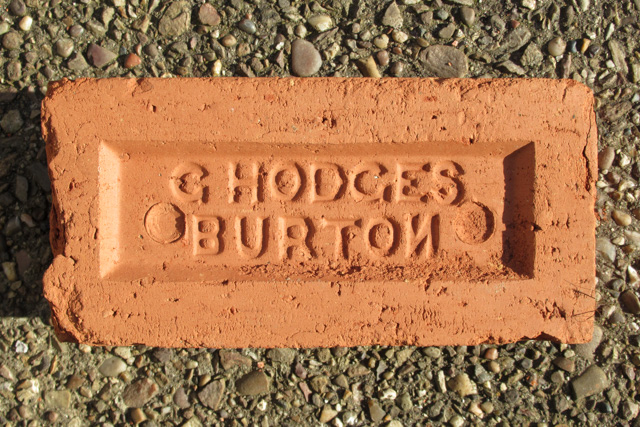
There were two brickworks on Shobnall Road as shown on the 1882 & 1900 OS maps below. One was owned by Lowe & Sons & the other by George Hodges, but I have been unable to establish which yard was owned by which man. Both these gentlemen also owned brickworks at Winshill & I write about their other yards later. There are no more brickmakers recorded in trade directories as working on Shobnall Road, so it appears both these yards were started & closed by Lowe & Hodges. 

Updated - 12.4.20.
Derek in Australia has contacted me with this information which puts Lowe & Son at the green works & George Hodges at the yellow works. Many Thanks Derek.

"I lived on Reservoir Road for the first 25 years of my life & so the old clay pits were a magic play area for me. By then, of course, they were only being used as tips by builders Lowe & Hodges. I’m fairly certain that the one closest to Reservoir Road was used by Lowe’s & the other by Hodges. This might help you in working out which one was owned by which company. There was the remnant of the brickworks there in the form of a short length of tunnel which was an especially great play area."

 © Crown Copyright. Reproduced with permission of NLS/Ordnance Survey 1882.
 © Crown Copyright. Reproduced with permission of NLS/Ordnance Survey 1900.

Photo by Frank Lawson.


Lowe & Sons are listed in Kelly's 1880 edition on Shobnall Road, Burton & this entry continues until Kelly's 1900 edition. How long after 1900 Lowe & Sons continued to produce bricks at this yard is unknown, but the works is not shown on the 1920 OS map, only the outline of the clay pit is shown.


George Hodges was a Stonemason who established a building company in 1877. The first reference to George Hodges owning a brickworks is in Kelly's 1884 edition when he is listed in the Brick & Tile Makers section as brickmaking on Shobnall Road. The next entry in Kelly's 1892 edition lists him at 115, Byrkley Street, Burton & I have established from the 1881 census that this was his home address. Kelly's 1896 edition lists him at 96, Derby Street & this was his builders yard/offices. The census entries for George Hodges only list him as a Builder or Building Contractor & not as a brickmaker, so it appears he was making bricks for his own use. His building company is still going strong today, but alas there are no more Hodges running the company as Geoffrey Hodges, a bachelor without any heirs retired in 1977. Back to the brickworks & the Shobnall Road yard continues to be listed in Kelly's 1904, 1908 & 1912 editions. George Hodges died in 1916, so the brickworks may have closed sometime between 1912 & 1916. The yard is not shown on the 1920 OS map only the outline of the clay pit. After George's death the building company was run by his son, Frederick Hodges.

Courtesy of Ashby Museum.


Winshill

The 1882 OS map shows there were four brickworks in Winshill, two on Bearwood Road & two on Ashby Road, but by 1900 there were only three.

© Crown Copyright. Reproduced with permission of NLS/Ordnance Survey 1882.

© Crown Copyright. Reproduced with permission of NLS/Ordnance Survey 1900.


A small company booklet produced by building firm Lowe & Sons in Burton Library records Thomas Lowe established his building company in 1825 then opening his Winshill brickworks on the south side of Ashby Road in 1832. Thomas Lowe died in 1878 & the brickworks was then run by building firm Lowe & Sons who are listed in Kelly's 1876 to 1896 editions at Winshill. Thomas's first son William had died in 1887, so it was his second son Thomas B. Lowe who was now running the company. William's son Thomas E. Lowe later joined his uncle Thomas in the running of the company. Kelly's 1900 & 1904 editions now actually records the brickworks address as Ashby Road, Winshill. I have been unable to established if Lowe's owned the green or red works on Ashby Road as shown on the 1882 & 1900 OS maps above. As previously wrote Lowe & Sons owned another brickworks on Shobnall Road, Burton. There are no more Lowe & Sons trade directory entries after 1904 & the 1920 OS map only shows two old clay pits on Ashby Road, so it appears this works closed sometime before WW1 & Lowe's were no longer making their own bricks. 

Photographed at the Silk Mill Museum, Derby

George Hodges second brickworks was on Bearwood Road, Winshill & this is the yellow coloured yard on the 1882 & 1900 OS maps above. This Bearwood Road/Winshill works is only listed in Kelly's 1900 & 1904 editions, so it unknown how long George Hodges actually owned this works with finding other brickmakers also operated in Windshill before George Hodges' TD dates & these brickmakers are listed after the next brickmaker. This yellow coloured Bearwood Road works is not shown on the 1920 OS map.

Photo by Frank Lawson.

The only info found on this brickmaker is that Richard Jordan is recorded as owning the Steam Brickworks, Winshill, the date of which is unknown, also no trade directory entries have been found for this brickmaker. However Kelly's 1904 &1908 editions lists the Jordan Brothers at London Road Wharf, Derby, so this may be Richard Jordan ? Which of the four brickworks shown on the maps above was the Steam Brickworks is unknown.

Courtesy of Ashby Museum.

Herbert B. Smith is listed in Kelly's 1880 to 1892 editions brickmaking in Winshill. Which of the two brickworks on Ashby Road (green or red) as shown on the 1882 map above Smith owned is unknown. The other works was owned by Lowe & Sons.


I now list the Winshill brickmakers who's bricks have still to be found & are listed in trade directories or info about them has been found on the web. Which of the four brickworks in Winshill they owned is mostly unknown.

T. Cooper Kelly's 1864 edition.

A web article records William Bond as brickmaking on Bearwood Road (yellow or purple yard) in the 1850's then Mrs. C. Bond is listed as brickmaking in Winshill in Kelly's 1876 edition.

Benjamin Gregory, Kelly's 1876 edition.

Morris & Edwards, Kelly's 1896 edition.  


Anslow

Anslow is a village 3 miles north-west of Burton on Trent.

 © Crown Copyright. Reproduced with permission of NLS/Ordnance Survey 1881.

 © Crown Copyright. Reproduced with permission of NLS/Ordnance Survey 1920.

Photo by Nigel Furniss.

William Harrison is listed as brickmaking at the Anslow Brickworks (coloured yellow on the two maps above) in Kelly's 1896 to 1908 edtions. In the 1911 census Herbert Harrison (William's son) is listed as a Brickworks Manager, so running the works for his father. I then found Kelly's 1912 edition now reads Herbert Harrison, Anslow, so Herbert had now taken full control of the works. The next directory entry in Kelly's 1916 edition lists Harrison & Co. at the Anslow works same as this brick & this is the only entry for Harrison & Co. A Derbyshire Advertiser newspaper article dated the 12th of September 1919 reveals Sir Oswald Mosley of Rolleston Hall, Burton was selling his home, estate & the Anslow Brickworks at auction, so from this information I have concluded the Harrison family only leased the works from Sir Oswald Mosley & this lease appears to have ended when Sir Oswald Mosley put the brickworks up for sale. I then established from another Derbyshire Advertiser notice dated the 12th of March 1921, the brickworks did not sell in this 1919 auction with this notice advertising the sale of the brickworks plant & machinery at an auction on the 23rd of March 1921 at 11 o'clock. Therefore that accounts for the brickworks still being shown on the 1920 OS map with the decision being made to sell the works plant & machinery rather than to wait for a buyer to purchase the brickworks as a whole. 


I wish to thank the following :-
National Library of Scotland/Ordnance Survey - maps.
https://maps.nls.uk/index.html
Nigel Furniss - photos.
Frank Lawson - photos.


Wednesday, 19 June 2019

Birmingham Brickworks - part 5

In Birmingham Brickworks part 5, I cover brickmakers who operated in Erdington, Washwood Heath, Handsworth, Mill Pool Hill near Warstock, Hamstead & Sutton Coldfield.


William Nock, Erdington


I have established there were four William Nocks who ran this brickworks & this family business was started by William Nock who was born in Derby in 1826. However census listings records his age/birth year between 1823 & 1828, so I have used 1826 as recorded on his marriage certificate. Albert Stephenson writes in his 1933 book that "He never knew a time when a Nock was not making bricks at the Holly Lane Brickworks." 

Some of this early Nock family info came from an article written in 2008 by Shaun J. on this website. Update 6.8.19 - I have now added some photos & info received from John Roberts who's Grandfather also named John Roberts worked at Nock's from around 1908. John worked his way up the Company to become Works Manager & then a Director. I have blended this new info & photos into the timeline of the Company. A newspaper article received from John also extends the date when Nock's Holly Lane Brickworks closed to 1971.

William Nock (b.1826) moved to Birmingham in 1851 & at the time of his marriage to Ann Nock on the 10th of July 1852, he is recorded as a "gun stocker" on his marriage certificate. A man who fitted wooden stocks to gun barrels. Shaun has tried to establish if William & Ann were related with them both being Nocks, but from reading the forum page, he has not been able to make any connection. I am thinking they were distant cousins, hence the reason why William moved to Birmingham & married Ann. William in the 1861 census is listed as a hosier. 

A visit to the Library has revealed that in the 1871 census William is listed as a builder & living in Osborne Place, in the hamlet of Aston Manor, Birmingham together with his wife Ann & 3 children. Their eldest son, William, aged 15 & born in 1855 is listed as a carpenter. Shaun next writes that William Nock (b.1826) purchases a brickfield on Holly Lane, Erdington from the Reverend Horace Newton in 1875. I have coloured this Holly Lane brickworks yellow on the 1902 OS map below.    

© Crown Copyright. Reproduced with permission of NLS/Ordnance Survey 1902.

The first trade directory entry in the Brick Makers Section for W. Nock & Co., Holly Lane, Erdington appears in Kelly's 1876 edition. So this will be our first William born 1826. This 1876 trade directory entry for W. Nock & Co. is repeated up to Kelly's 1892 edition. Shaun writes that around 1887 William handed over the brickworks to his son William (b.1855) together with a 21 year lease on the property, but I have found that the 1881 census records William (b.1855 aged 25) as a Brick-Master employing 25 workers & living on Holly Lane together with his wife, Emma aged 25 & their son, William, aged nine months. So from this census info we can now bring forward the 1887 date when the brickworks was transferred over to William (b.1855). The 1891 census records William (b.1855) as William Nock junior, a Brick Manufacturer aged 35, together with his wife Emma, aged 35 & son, William, a scholar, aged 10 & all still living on Holly Lane.  


Meanwhile the 1891 census records our first William Nock (b.1826) as a Brick Manufacturer, aged 64, wife Ann aged 69 & daughter, Kate, aged 30, all living on Orchard Road, Erdington.

William Nock (junior) b.1855 died in 1893 at the tender aged of 38. We then find that Kelly's 1895 edition now reads W. Nock (exors of) & this entry is repeated up to Kelly's 1900 edition. It was after 1895 that the executors of William junior's Will put the brickworks up for sale, but no one took up on the offer, so I am assuming that our first William Nock born in 1826 was now running W. Nock & Co. again as one of the executors of his son's Will because Emma & William junior's son, William, born 3rd of July 1880 was only 13 when his father died. 

The following three photos of Nock's workers have been sent to me by John Roberts & are thought to have been taken in the 1890's.


The aerial photograph below, also from John's collection was taken by Geographia & may date to around 1900 because by 1908 new buildings had been erected & these are shown in a photograph later in the post.


We next find in the 1901 census that our third William Nock born 1880 & now aged 22 is recorded as Manager of a Brickworks & boarding with Mary A. Haddon aged 61 & her daughter Isabella, aged 25 on Wesley Road, Erdington. 

Kelly's 1903 trade directory now has the addition of junior in the entry & reads William junior Nock (exors of), Holly Lane, Erdington & as just wrote we know from the 1901 census that William Nock born 1880 was now running the Holly Lane Brickworks. In 1904 the first William Nock, born in 1826 died aged 78. 

With our third William Nock running the Holly Lane brickworks as Manager, entries in Kelly's 1904 to 1915 editions still read William junior Nock, (exors of), Holly Lane, Erdington, so I am assuming even by 1915 William junior's Estate had not been sorted. 

Photo by Alex Cartwright who found this Exors brick in his garden in Sutton Coldfield.

As wrote at the top of this entry John Roberts' Grandfather John Roberts started at Nocks Brickworks around 1908 with him previously working at P. & S. Wood's Pumphouse Brickworks which had closed in 1904. John soon rose up the ladder at Nocks becoming Works Manager & by 1933 John was a Company Director. John known as "Jack" or the "Governor" celebrated 25 years at the Company on the 25th of June 1933 & a citation reads - 25th Anniversary of Service with William Nock Limited. Presented to Jack by his Co-Directors, William Nock, Isabella Nock & A. Bridgewater. Dated 25th of June 1933.

The following photograph is thought to have been taken after 1908 as John Roberts is in one of these photos & I have used a close-up version of the same photo to show John.


John Roberts is the gentleman standing in the background to the left of the first horse & cart, also note the Nock steam lorry on the right. I expect it was soon to be the end of using horses & carts at the works with the introduction of mechanised vehicles.

As I have digressed telling you about John Roberts I now go back to the 1911 census which lists our third William Nock (b.1880) as a Brick Manufacturer, living in Erdington & now married to Isabella Haddon. In 1901 William was living with Isabella & her mother, so love must have blossomed. This 1911 census also reveals that William's widowed mother, Emma was living with her son & daughter-in-law. A search for the marriage date for William & Isabella has resulted in finding an index entry recording they were married in either April, May or June 1905. The finds don't stop there, the 1939 England & Wales Register also reveals that a son was born to William & Isabella on the 5th of July 1911 & you've guessed it, they named him William !!!


It appears by 1921 William Nock junior's (b.1855 - d.1893) affairs had been sorted because Kelly's 1921 edition now reads William Nock Ltd., Holly Lane, Erdington & this entry is repeated up to the last available Kelly's trade directory in 1940. Running this new company was William Nock, our third William born 1880. Albert Stephenson writes about this William in his 1933 book - "After his father's death, "Billy" Nock greatly improved the works, that I now believe the output exceeds any other single plant in the district." Stephenson continues to write that Billy Nock was a member of the pre-War Brick Makers Associations & promptly joined the present 1917 Association, being at once elected to the Committee of Managers. "Billy" Nock is our "star" golfer, having twice won the Chairman's Cup, And at our social gatherings he is always called upon to sing the "Brickmakers' Anthem" !  I wonder how that went !!!

The Holly Lane Brickworks in 1937.


I mentioned earlier the 1939 England & Wales Register & in this listing it records William Nock (b.1880) as Brick Manufacturer & then on the next line, his son William junior (b.1911) also as a Brick Manufacturer, so it appears father & son were running the brickworks together. This Register records William senior, his wife Isabella & William junior living at 5, Beech Hill Road, Sutton Coldfield, a very "affluent" area. 

Ray Shill writes in his book that the Holly Lane Brickworks closed around 1952, but I have three Nock adverts dated 1954, 1959 & 1962. 

Birmingham Post dated 2nd of September 1954.

Walsall Observer & South Staffordshire Chronicle dated 13th February 1959


Coventry Evening Telegraph dated 21st September 1962

So should Ray Shill's book read 1962 & not 1952 ? Also fellow brick collector, Ray Martin has sent me this info - "By the late 1960’s, the works had closed and the clay pit was used for waste disposal, including hazardous material such as acids, asbestos and medical waste. After the filling had been completed, it was capped with a six-foot earth cap."

I have therefore come to the conclusion that the Holly Lane Brickworks had closed by the mid 1960's with William Nock junior (b.1911) at the helm because his father, William "Billy" Nock (b.1880) had passed away in 1955 aged 75. 

From John Roberts info, William junior born 1911 had the middle name of Haddon, but was known as Bill Nock. A Company letterhead dated 29th of January 1952 gives the directors as, William Nock (b.1880), Chairman, William Haddon Nock (b.1911), Managing Director & R. Starling, Works Director.

John Roberts has also sent me the Birmingham Evening Mail article below dated 6th January 1977 which reveals that due to the clay reserves being exhausted the Holly Lane Brickworks closed in 1971. So we can now say for certain that 1971 was the end of brick production at the Holly Lane Brickworks. 
  

According to this article the year the Company would have celebrated it's Centenary was 1978, but we know from my research that Nock's are first listed making bricks in Kelly's 1876 Trade Directory & that the "first" William Nock purchased the Holly Lane brickfield in 1875, so the Centenary of the Company would have been in 1975/6 & not 1978. It appears William "Bill" Haddon Nock was unaware of these 1875/6 dates when the Company was established or he would have celebrated the Company's Centenary in 1975. With Bill saying in the article that he could not wait until 1978 for the party, I am wondering if he knew his health was failing because he sadly died on the 19th January 1978. His death is recorded in Banbury, Oxfordshire.

Photos from John Roberts Collection.

These two photos of Nock's lorries & small van may have been taken in the late 1930's / 1940's & it is thought that the gentleman to the left of the small van is Sam Redding, Works Manager & another gentleman is thought to be Henry Reed, father of Henry Reed the poet & author. 

I have found from the web that there have been numerous applications to build houses on the former Holly Lane brickworks site over the last 40 years, but all have been dismissed. Local residents are today still battling the latest 2018 application to build 200 homes on this contaminated land.

While searching trade directories for William Nock I found a George Nock who is listed in Kelly's 1895 & 1896 editions brickmaking on Summer Road, Erdington (coloured yellow on the 1886 OS map below). The 1871 census has revealed that George Nock was born in 1865 to William (b.1826) & Ann Nock, so George was the younger brother to William Nock (b.1855 our second William). George would have been 30 in 1895 & as previously wrote William born 1855 died in 1893. There is the option that George was running the family business with his father after William's death because William's son was only 13 when his father died & it was at a later date that this William born in 1880 became our 3rd William & owner of the Holly Lane Brickworks. George Nock aged 26 in the 1891 census is recorded as a Manager at a Brick Yard & this entry ties in with the 1895 & 1896 trade directory entries for him as the owner of the Summer Lane Brickworks. The 1891 census also records George Nock & his wife Beatrice Lizzie Nock were living at Mona Villas, New Street, Erdington.

Ancestry has also revealed that George Nock married Beatrice Lizzie Haddon (b.1871) in 1890 & Beatrice was the older sister to Isabella Haddon (b.1875) who in 1905 married George's nephew, William Nock born 1880, our third William. This Haddon sister connection may explain why William was boarding with the Haddon's as recorded in the 1901 census.

© Crown Copyright. Reproduced with permission of NLS/Ordnance Survey 1886.

The 1902 OS map no longer shows a brickworks on Summer Road & houses had been built on most of the site, so it appears George Nock only operated this site for a few years. 

The 1901 census now records George Nock as a Timber Merchant, together his wife Beatrice Lizzie & five children ranging from 9 to 1. From a death index I next found that George died in either January, February or March 1907 aged 42. So George's foray into brickmaking may have only been between 1891 to 1896.

I have to note that his brother William (2nd William) born 1855 also died young at the of aged 38 in 1893, then on the other hand the first William born 1826 lived to be 78 & the third William born 1880 got to 75. The fourth William born 1911 was 67 when he passed away.

I found this snippet of information in Albert Stephenson's 1933 book. Albert writes "G.H. Machin owned a small hand-made yard (coloured purple on the 1886 OS map above) situated near to the Railway Station which was taken over by the first William Nock (b.1826)." As no date is given this would have been after 1892 when there are no more trade directory entries for Machin. The 1902 OS map no longer shows this small yard only the former clay pits with the newly built houses on New Street occupying the site were the buildings & kilns had once stood. 


Before I sign off on this Nock entry, I found this Nock - Star of David brick at Cawarden Reclamation Yard. The only other company to use this symbol was P. & S. Wood of West Bromwich. It was a chance conversation between Ray Martin & a visitor to the Newhall Water Mill Museum as the man was looking at Ray's bricks which prompted him to tell Ray that his Grandfather worked at Woods until it's closure in 1904, moving to Nocks shortly after. Ray was unaware of me having this Nock - Star of David brick at the time, so this now begs the question, did this gentleman's Grandfather have anything to do with Nocks using this symbol which Woods had used since 1884 as a Trade Mark ? 

With now being in touch with this visitor, John Roberts, I can now reveal that these bricks were made when John's Grandfather, John Roberts was a Director at the Company & this will have been after 1933. The reason why John Roberts produced bricks with the Star of David stamped in them is not known by his Grandson, but with John being at P & S Woods at the time when Woods produced their Star Of David bricks I can only assume with the sale of these bricks being a success in promoting Woods, John Roberts must have thought that doing the same would promote Nock's brick sales. John Roberts remained a Director at Nock's until his death. 

Many Thanks to John Roberts (Grandson) for sending me the info on his Grandfather, John Roberts & the photos of Nocks, which now enriches this entry.


I found this Nock Star of David variation at Cawarden in October 2023.


T. Haines, Erdington


A search of the web & trade directories has drawn a blank for brickmaker T. Haines in Erdington. The design of the frog suggests it was made in the 1860's/70's. As to the location of Haines yard, the 1886 OS map below shows two operational brickworks, one on Summer Lane (now Summer Road) & one on Sheep Street (now Station Road) & Haines could have worked either of these two works. This map also shows three ponds on Brick Kiln Lane & these ponds could have been the clay pits to three more earlier brick yards which could have been operational in the 1860's/70's.

 © Crown Copyright. Reproduced with permission of NLS/Ordnance Survey 1886.


Powley's, Erdington

Photo by Angel Rose.

In January 2022 Angel Rose sent me this image of a part brick which she found in a Birmingham park. It appears to say Powley's, Patent, ???? Lane, Erdington. Now I have found two Erdington yards where this brick could have been made. Trade directories only list Henry Powley at Hay Mills, Birmingham between 1879 & 1890, so this brick will have been made pre -1879. 

My first option is Holly Lane, Erdington & as wrote William Nock purchased the Holly Lane brickfield from the Reverend Horace Newton in 1875, so there is the option that Henry Powley leased this brick yard from Newton in the early 1870's. 

My second option & the one I now prefer is that this brick says Powley's, Patent, Summer Lane, Erdington & I have coloured Summer Lane green & yard yellow on the 1885 OS map above in the Haines entry. With only a full brick or the other half of this one turning up will we get the answer to this conundrum. As a footnote this Summer Lane yard was owned by the first William Nock's son, George in 1895 & 1896. 


I now move on to Washwood Heath with brickmakers Richard Taylor & Edward Hales who started off brickmaking independently, then as a partnership, followed by Hales on his own. I then write about Priest & Phipps at Washwood Heath.


Richard Taylor

© Crown Copyright. Reproduced with permission of NLS/Ordnance Survey 1886. 

The first newspaper reference found to Richard Taylor as operating a brickyard in Washwood Heath is November 1864 & it appears he had taken over the yard previously run by Cornelius Bagnall who is last recorded in a newspaper at the Washwood Heath brickyard in September 1863. Richard Taylor is listed as brickmaker in Saltley in Kelly's 1867 & 68 editions & from Albert Stephenson's book, Richard Taylor's yard was called the Heath Brickworks & was situated near to the Midland Railway & the Warwick & Birmingham Junction Canal. I have coloured this yard purple on the 1886 OS map above which was accessed via a road (also coloured purple) which connected to Aston Church Road. 

Taylor then moved to a new yard situated on Washwood Heath Road (coloured green on the map above). From info found this move had taken place by 1872 with Richard Taylor now being in partnership with Edward Hales at the Washwood Heath Road Works. The purple works was next run by Priest & Phipps & I write about them later.

As a footnote before I write about this Taylor & Hales partnership, I have found two more Taylor entries in trade directories & these are for Thomas Taylor at Washwood Heath in White's 1850 & Slater's 1852 editions, then John Taylor at Washwood Heath near Saltley in Slater's 1852 edition, so maybe these two brickmakers were related to Richard Taylor & both had been at the purple coloured brickyards in the 1850's.  


Taylor & Hales


We next find Richard Taylor is joined by Edward Hales at the Washwood Heath Works, coloured green on the 1886 OS map below. The duos first trade directory entry is in Kelly's 1872 edition & it reads Taylor & Hales, Washwood Heath, Birmingham. Edward Hales up to the 12th of March 1869 had been in partnership with Josiah Derrington at Leopold Street in Birmingham. More can be read about Derrington & Hales in Birmingham Brickmakers - part 2. 

© Crown Copyright. Reproduced with permission of NLS/Ordnance Survey 1886. 

White's 1873 edition however only lists Richard Taylor at Washwood Heath, but we then find in White's 1875 edition it has reverted back to Taylor & Hales. This partnership continues to be listed in Kelly's 1876 to 1882 editions. We then find from Kelly's 1883 edition Edward Hales is operating this Washwood Heath works on his own, so had Richard Taylor retired from brickmaking or had he passed away ?


Edward Hales


Edward Hales is listed at Washwood Heath Road, Saltley in Kelly's 1883 to Kelly's 1905 editions. With Edward first listed as brickmaking in 1858 I have estimated his age to be around 70 in 1905, so I can only assume he had retired from brickmaking or had passed away soon after 1905. There are no more brickmakers listed in trade directories as owning this works & it is no longer shown on the 1913 OS map, so I am taking it that this brickworks close soon after 1905.


Priest & Phipps

Photo by Tariq Yasin.

Certainly by 1872 Richard Taylor had vacated the Heath Brickworks, Saltley, coloured purple on the 1886 map below & the next owners of this works were Charles Priest & Thomas Frederick Phipps who may have taken over this works straight after Taylor had left, however the first newspaper reference found to Priest & Phipps owning this works situated just off Aston Church Road is December 1878. Please note the spelling on the brick is Preist which is incorrect. 

An article in the London Gazette records Thomas Frederick Phipps & Charles Priest trading as Phipps & Priest, brickmakers in Washwood Heath had dissolved their partnership on the 22nd of May 1880 & Charles Priest would then carry on the business at the same premises. I then found Charles Priest is recorded as brickmaker at Washwood Heath in Kelly's Warwickshire 1880 edition. However this venture on his own did not last long with the Birmingham Daily Mail dated 22nd June 1881 reporting Charles Priest of the Washwood Heath Brick & Quarry Works, Cranemoor Lane, Washwood Heath had filed a petition for liquidation with liabilities of £600, and assets not yet ascertained. Ash Cottage, Washwood Heath is given as his home address. There is also a Notice in the London Gazette recording this liquidation petition. I also note this is the first reference to this purple brickworks as being on Cranemoor Lane. It appears this brickworks closed after Priest had gone bankrupt as it is no longer shown on the 1900 OS map, only the old clay pits are recorded.

 © Crown Copyright. Reproduced with permission of NLS/Ordnance Survey 1886. 


Edward Mullett


Edward Mullett is listed in Kelly's 1876 edition with the address of Holyhead Road, Handsworth. Kelly's 1879 edition now gives his address as Nursery Brick Yard, Handsworth. Kelly's 1880 & 1882 editions are the same entry as 1876. 

Ray Shill writes in his book that in 1883 the Nursery Brickworks on Holyhead Road, Handsworth possessed a 20hp horizontal engine, egg-ended boilers, pug-mill & rolls, brick press & a semi-dry brickmaking machine in addition to the kilns & sheds. The exact location of Mullett's yard is unknown. The 1886 OS map below (earliest available) shows no brick yards working or disused on Holyhead Road, so after studying this map, the only option I can put forward is the area which I have coloured green, with the pond being the former clay pit. With the works being called the Nursery Brickyard, it suggests it had occupied a former agricultural business. I will update the entry is any new info comes to light. 

© Crown Copyright. Reproduced with permission of NLS/Ordnance Survey 1886.


Charles Payne


I have two sets of trade directory entries for Charles Payne, the first lists him brickmaking at Great Barr, Handsworth in Kelly's 1879 to 1882 editions. The works address in the 1882 entry is given as Great Barr, Perry Barr. The only potential brickworks that I can find on maps in the Great Barr area, is the one marked old clay pit (red) on the 1885 OS map below & this yard may have been owned by Charles Payne. Great Barr village is at the top of this map, Perry Wood (green) is to the north of the brickyard & Perry Barr village is just off to the right on the next map. I have to note that on the right side of this map there is a road called Brick Kiln Lane which goes from Tower Hill to Perry Barr. Although there are no marked brickworks on this lane, there may have been when Payne was working & his yard may have been on this lane. If any firm evidence turns up for the location of his yard, I will update the post. 

© Crown Copyright. Reproduced with permission of NLS/Ordnance Survey 1885.

Now on to the second entry for Charles Payne & he is listed in Kelly's 1903, 04 & 05 editions with the works address of Mill Pool Hill Brickworks, Mill Pool Hill, Hollywood, Kings Norton via Kings Heath. I have had no trouble in finding this works as it is clearly marked on the 1903 OS map below (coloured yellow). It is unknown which of these two works this C. Payne brick was made, but I am favouring the Mill Pool Hill Works.

© Crown Copyright. Reproduced with permission of NLS/Ordnance Survey 1903.


Hamstead / NCB Hamstead

 © Crown Copyright. Reproduced with permission of NLS/Ordnance Survey 1885.

A brickworks at Hamstead (coloured yellow on the 1885 OS map above) was erected in 1876, a year after Hamstead Colliery had been sunk in 1875, whether at this date it was actually owed by the Hamstead Colliery Company (formed 1875) is unknown. I have found several independent brickmakers owned this works before the Hamstead Colliery (1930) Ltd took over in 1938. I therefore have come to the conclusion that the brickworks was first owned by the Colliery between 1876 & 1888, then between 1888 & 1938 it was in the hands of individual brickmakers, with it then coming back under the control of Hamstead Colliery (1930) Ltd. / NCB until it's closure. 

So the first trade directory listing I have found for a brickmaker at this works is in Kelly's 1888 edition when it records William Bradford, 14, Franchise Street, Perry Barr, works, Hamstead, Birmingham. William Bradford's listing is repeated in Kelly's 1890 & 92 editions. We then find Joseph Sheldon is listed at this works in Kelly's 1895 edition. Kelly's 1897 & 1900 editions lists Joseph Sheldon with the works address of Old Walsall Road, Hamstead, Handsworth. Kelly's 1903 to 1921 editions next list Turner & Hadley at the Old Walsall Road, Hamstead works. Albert Stephenson writes in his 1933 book that "J.R. Turner was a builder who consumed most of the bricks produced at Hamstead & his partner William Hadley, was a very pushful salesman who was a "thorn in the flesh" to other Birmingham Brickmakers, until he joined with them in setting up the Brickmakers Association in 1917. After the retirement of Mr. Turner, "Billy" Hadley ran the yard until his expiration of his lease in 1927." As of yet no bricks stamped by the aforementioned brickmakers have been found.

We then find the Hamstead Brick Co. had taken over the brickworks from Turner & Hadley with this new company advertising they had recently installed a new kiln in 1929. It was said to be of a type invented by Alvis Habla of Czechoslovakia. The kiln was 84 ft long and 63 ft wide and was of the zigzag Hoffman type. The Hamstead Brick Co. spent £25,000 pounds on the modernisation of the works & this new kiln was capable of producing 250,000 bricks per week. The Hamstead Brick Co. is first listed in Kelly's 1932 edition with the address of Old Walsall Road, Great Barr & I think they were the makers of the Hamstead brick shown below. This Hamstead Brick Co. entry is repeated in Kelly's 1933, 36 & 37 editions. 

An article in London Gazette dated 28th of December 1937 reports that the Hamstead Brick Co. went into voluntary liquidation on the 22nd of December 1937 & this process was finalised on the 30th of September 1940 when liquidator, Kenric Allday set out his accounts of the winding up & dispersal of the Company's assets.    


With the demise of the Hamstead Brick Co. we find in Kelly's 1938 edition the listing for Hamstead Colliery (1930) Ltd. & they were now operating this Old Walsall Road brickworks. At some point a 20 chambered Staffordshire Kiln was built with each chamber holding 20,000 bricks. Clay shale was brought from the colliery via an aerial ropeway to the brickworks, a photo of which can be seen at this link.

 © Crown Copyright. Reproduced with permission of NLS/Ordnance Survey 1938.

With the Nationalisation of the Collieries in 1947, Hamstead colliery & brickworks came under the control of the National Coal Board & an example of a brick made by the NCB at this works can be seen below. 


In 1963 the works is recorded as producing pressed commons, but in March 1965 the colliery closed and it appears the brickworks followed suit with the photo in this link showing the derelict brickworks in June 1968.
https://www.search.birminghamimages.org.uk/Details.aspx?&ResourceID=2447&PageIndex=1&KeyWord=bricks


As a footnote, Hamstead Colliery (1930) Ltd. is recorded in the 16th of April 1954 edition of the London Gazette as being voluntarily wound up by it's members at a special meeting on the 7th of April 1954 with Stanley Roche MacDonald & Henry Brian Cookson being appointed joint Liquidators for the purpose of such winding-up. Signed S.R. MacDonald, Chairman.


Lloyd, Sutton Coldfield

© Crown Copyright. Reproduced with permission of NLS/Ordnance Survey 1887.

Recorded as Builders & Contractors in 1868, Charles Lloyd & Son are then listed in Kelly's 1872 edition as Brickmakers with the address of Holland Street, Maney, Sutton Coldfield. Holland Street was their home address. This listing for Charles is repeated up to & including the 1888 edition. It's not until the 1908 listing for Mark Lloyd, Charles' son, that we find that Charles had established two brickworks on Whitehouse Common on the east side of Sutton Coldfield, one was called the Sutton Old Yard, coloured yellow on the 1887 OS map above & the other was the Wheatmoor Brick Works which I have coloured green. I have established from trade directories that no other brickmakers were operating in Sutton Coldfield at this time, hence me coming to the conclusion that Charles started both these two works which were eventually run by Mark.

This brick was kindly given to me by Ray Martin.

Photographed at New Hall Mill & forms part of Ray Martin's Collection at the Mill.

Fellow brick collector, Ray Martin has found that Charles Lloyd was born around 1815 & had died by the 1891 Census, as his wife Dinah is listed as a widow in this Census & living with her son Mark (born around 1848) & his wife. Charles last trade directory entry is in Kelly's 1888 edition, so Charles died between 1888 & 1891. According to Ray, Lloyd & Son bricks were used to build Sutton Coldfield's Park & Town Railway Stations in 1879. 

 © Crown Copyright. Reproduced with permission of NLS/Ordnance Survey 1901.

I have used the 1901 OS map above to show how both works had expanded since the 1887 map.

This brick was kindly given to me by Ray Martin.

With Charles' last trade directory being 1888 we find that his son Mark first goes into partnership with Joseph Read Jones, as builders & brickmakers in Sutton Coldfield before running the Lloyd family's two brickworks on his own as recorded in Kelly's 1908 trade directory. This short lived partnership is recorded in a Notice in the London Gazette dated 16th of January 1891 when the partnership operating under the style of Jones & Lloyd was dissolved by mutual consent on the 31st December 1890. All debts due to & owing by the said late firm would be received & paid by the said Mark Lloyd. Dated 9th of January 1891. 
https://www.thegazette.co.uk/London/issue/26125/page/316

Mark Lloyd is listed in Kelly's 1892 edition with the address of Holland Street, Maney, Sutton Coldfield. For some unknown reason Mark is not listed in Kelly's 1900 & 1904 editions & he is next recorded in Kelly's 1908 edition with the listing of Lloyd's (Mark) Brick Works Ltd., Sutton Old Yard & Wheatmoor Brick Works, Sutton Coldfield. This entry is repeated in Kelly's 1912 & 1916 editions. According to Ray both works closed around 1930.


T. Smith, Sutton Coldfield

Photo by MF courtesy of the John Baylis Collection.

A notice in the London Gazette dated 26th of November 1872 records Thomas Smith an Auctioneer & brickmaker of High Street, Sutton Coldfield was declaring himself bankrupt. The notice summoned creditors of the aforementioned to attend the First General Meeting at the Tuns Hotel, High Street, Sutton Coldfield on the 10th day of December 1872 at three o'clock precisely. Signed W.M. Fellows, attorney for the said Thomas Smith. The location of Thomas Smith's brickworks is not recorded in this notice, but there is the option that it may have been the Sutton Old Yard, Sutton Coldfield which was in the hands of Charles Lloyd & Son from 1872. 

This post now completes Birmingham Brickmakers to which I have brick images for. That is until anymore new named Birmingham bricks turn up, so if you have any images of bricks not featured in any of my five Birmingham Posts, please send them along to my e-mail address which can be found on the Links & Contact Tab & I will add them to the appropriate post with a credit to the sender. Thanks. 


I wish to thank the following :- 
National Library/Ordnance Survey - maps.
https://maps.nls.uk/index.html
Nock Adverts in this post were found on this website.
The British Newspaper Archive
Chris Thornburn & John Baylis - for allowing me to photograph their brick collections.
John Roberts - Nock photos & Info.
Alex Cartwright - Nock brick photo.
Hamstead Miners Memorial Trust - Info.
David Kitching - info.
Ray Martin - Info & bricks.
I have gathered some information from a book called Workshop of the World - Birmingham's Industrial Heritage by Ray Shill to whom I am indebted.